
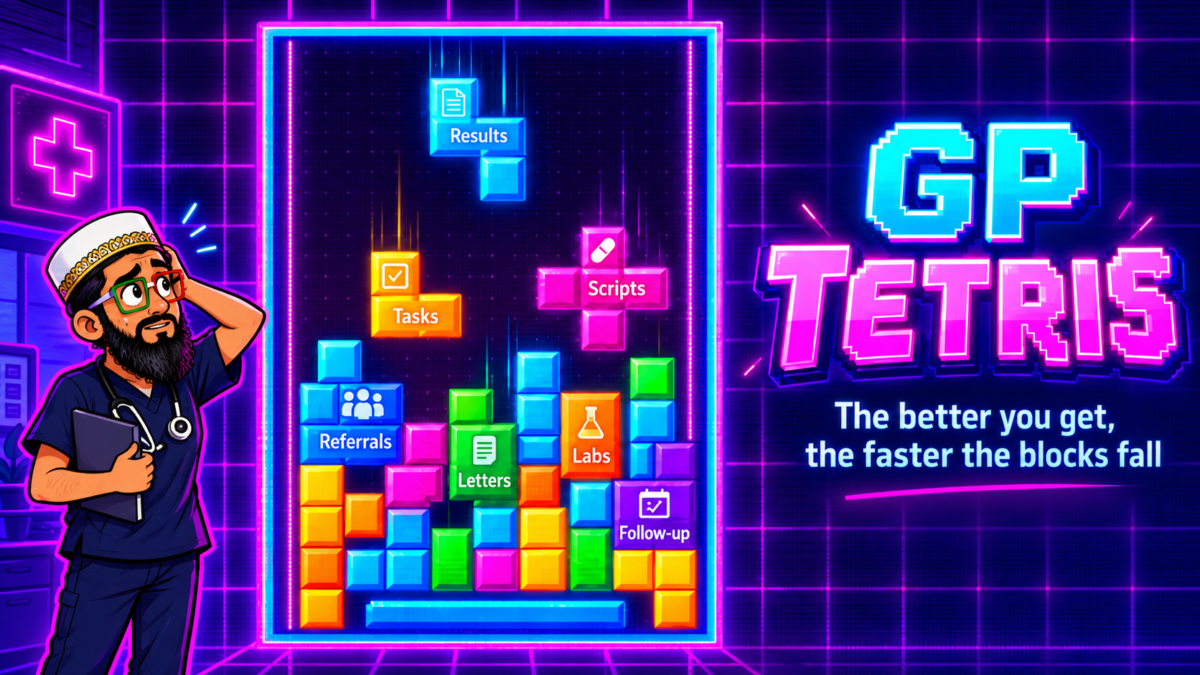
GP Tetris: The Better You Get, The Faster the Blocks Fall
I think I’ve finally found the perfect video game to explain what it’s like being a GP.
It’s not Call of Duty. Although some duty doctor sessions might make you think otherwise.
It’s not Grand Theft Auto. Although the number of people trying to steal ten minutes of your time is impressive.
It’s Tetris.
That beautifully simple game where blocks fall from the sky, you arrange them into neat little rows, and when you complete a line, it disappears.
Brilliant.
Except there’s a catch.
The better you get, the faster the blocks fall.
Welcome to general practice.
Why clearing the workload in general practice never seems to mean there’s less work
Level 1: A Nice, Manageable Monday Morning
You start the game with a relatively clear screen.
You’ve got your appointments booked, a sensible number of clinical tasks, a few prescriptions to review and maybe even time for a cup of tea.
Then the blocks begin falling.
A patient with a sore throat. Nice simple square block.
A blood pressure review. An L-shaped piece. Requires a little manoeuvring.
A complex multimorbid patient with diabetes, heart failure, chronic kidney disease and a medication list longer than your supermarket receipt.
Ah. The dreaded T-shaped block.
Still, you’ve been playing this game for years.
You rotate, rearrange and make everything fit.
You finish the consultation, request the blood tests, adjust the medicines, arrange a follow-up and send the referral.
Line cleared!
Except, unlike actual Tetris, that block hasn’t entirely disappeared.
It’s just gone somewhere else.
Level 2: The Blocks That Come Back
Remember those blood tests you requested?
They’re back.
The patient needs a medication change.
The prescription requires monitoring.
The referral has been rejected because apparently you’ve used the wrong form, despite having included all the relevant information.
The hospital has sent a letter asking you to arrange further investigations.
And the patient has contacted reception because the pharmacy can’t get that medication as it is ‘out of supply’ and they are not sure what to do next.
Some of that work is entirely appropriate. Good medicine involves continuity, monitoring and follow-up.
But some of it exists because of inefficient processes, poor communication or work being shifted between NHS organisations.
In GP Tetris, every block you clear has the potential to return as three smaller blocks.
And those smaller blocks don’t conveniently arrive together.
They turn up across your clinical inbox, prescribing tasks, pathology results, documents and online consultation system.
Occasionally, they land just as you’re about to go home.
Level 3: Someone Presses the Fast-Forward Button
You’ve become rather good at managing the blocks.
You’ve introduced online consultation.
Improved your prescribing workflow.
Automated some routine tasks.
Trained your reception team.
Used pharmacists, nurses and other clinicians more effectively.
Maybe you’ve even started using AI like AVT to save time on documentation.
Fantastic.
Your practice is now more efficient.
So what happens to the time you’ve saved?
More appointments.
More requests.
More activity.
A new enhanced service.
Another target.
Another expectation that general practice can absorb a bit more work.
The blocks start falling faster.
And here’s the frustrating thing: some of these improvements really are improvements.
I support using technology to improve access. It can help those who can use it, enabling capacity to help those who need extra attention.
I want practices to work efficiently. I don’t believe the answer to every problem is simply asking for more money while refusing to change how we work.
This can even include using automation and AI to enhance the care we offer.
But there has to be a point where productivity improvements translate into sustainable workload, better continuity and safer care.
Otherwise, we’re not becoming more efficient.
We’re simply getting better at surviving a faster game.
Level 4: The Invisible Blocks
Here’s something that might surprise people who don’t work in general practice.
Not every block is an appointment.
In fact, a significant proportion of our work happens when there’s no patient sitting in front of us.
Reviewing results.
Checking medicines.
Reading hospital letters.
Responding to clinical queries.
Coordinating care.
Supporting colleagues.
Reviewing patients who have deteriorated.
Supervising trainees or other roles
Engaging with PCNs or neighbourhoods
Safety screens and audits
Mandatory training that repeats itself
And dealing with the countless small pieces of work needed to keep patients safe like keeping up to date with every possible condition
These are the invisible blocks.
They still occupy space on the screen.
They still take time.
But they’re not always visible in the headline measures of GP activity.
We regularly discuss how many appointments general practice delivers.
Much less often do we discuss the workload those appointments generate.
This isn’t just my impression.
NHS England’s own appointment statistics explicitly acknowledge that appointment data does not represent the full range or complexity of work carried out in general practice.
And an RCGP report published in 2026 highlighted the considerable time lost to unnecessary and hidden workload generated by wider system inefficiencies.
We’re measuring the lines being cleared.
But not all the blocks still falling.
Level 5: Multiplayer Mode
Fortunately, general practice isn’t a single-player game.
We’ve got pharmacists, nurses, physician associates, healthcare assistants, care coordinators, GP assistants, social prescribers, administrative teams and many others.
And this is where GP Tetris can get much better.
The right block, in the right place, managed by the right person.
A medication query goes to the pharmacist.
An administrative request goes to someone who can resolve it without unnecessary clinical involvement.
A patient needing continuity sees the clinician who understands their history.
Great teamwork should make the screen easier to manage.
But here’s the problem.
Moving a block from one player’s screen to another doesn’t mean you’ve cleared it.
It may simply mean somebody else is now struggling to fit it in.
And if every task ends up coming back to the GP for approval, supervision, signing or final responsibility, we’ve created an elaborate multiplayer system where one player still has to finish every level.
That’s not necessarily multidisciplinary working.
Sometimes it’s just a complicated way of distributing the same workload.
The Boss Level: When the Screen Is Full
Eventually, in Tetris, the screen fills.
It doesn’t matter how experienced you are.
It doesn’t matter how quickly you rotate the blocks.
There comes a point where you physically cannot make another piece fit.
Game over.
In general practice, it’s not quite so simple.
We don’t get a Game Over screen.
Instead, people stay late.
Skip lunch.
Catch up with results at home.
Reduce their sessions.
Or eventually decide they can no longer keep playing.
And the consequences aren’t confined to the workforce.
They affect patients waiting for care, continuity of treatment and the time available to make complex clinical decisions safely.
That’s why I find the repeated focus on doing more increasingly frustrating.
More appointments.
More access.
More activity.
More productivity.
But where is the discussion about the speed of the blocks, their complexity and the size of the screen?
Can We Change the Rules?
I don’t think the answer is to stop playing Tetris.
General practice should absolutely modernise.
We should remove unnecessary processes, use better technology, delegate appropriately and challenge outdated ways of working.
But we also need to change how we judge success.
First, measure the whole workload. (Yes I’m looking at you NHS England and your GPAD rules on appointments.)
Also, an appointment is only one part of patient care. Clinical administration, prescribing, follow-up and coordination need recognition and protected time.
Second, stop rewarding the transfer of work. If an NHS pathway moves a task from hospital to primary care, the responsibility, resources and clinical governance must move with it. Not after – with.
Third, use technology to remove blocks, not just make them fall faster. Saving five minutes on documentation is useful. Automatically filling those five minutes with additional unfunded tasks is not necessarily progress.
Fourth, recognise complexity. Ten simple consultations aren’t equivalent to ten highly complex patients. Counting contacts alone won’t capture this.
Finally, allow teams to use efficiency gains to create resilience. Sometimes the best use of saved time is an extra appointment.
Sometimes it’s better continuity, safer follow-up, supervision or simply finishing work within contracted hours.
The BMA’s Safe Working guidance makes an important distinction between the work that could be requested of general practice and the work that can be delivered safely within available capacity.
That’s a distinction we need to take much more seriously.
The Final Line
The problem with GP Tetris isn’t that GPs don’t know how to play.
Most of us have spent years getting remarkably good at it.
We’ve learned to rotate the blocks, spot the gaps and clear lines that really shouldn’t have been possible.
We’ve introduced better systems, expanded our teams and found increasingly creative ways to manage demand.
But even the best Tetris player eventually loses when the game keeps speeding up.
And perhaps that’s the most important lesson.
A better NHS shouldn’t depend on how quickly its staff can clear the blocks. It should ask why so many blocks keep falling in the first place.
Because unlike Tetris, when the screen fills up in general practice, it isn’t just the player who loses.
It’s the patients too.
DrGandalf — eGPlearning
P.S. If you want to try and have a go at a version of GP Tetris I have created on the back of this article, you can either play below or bookmark the link below and share your score if you can survive..
On desktop, click the game once before using the keyboard.