
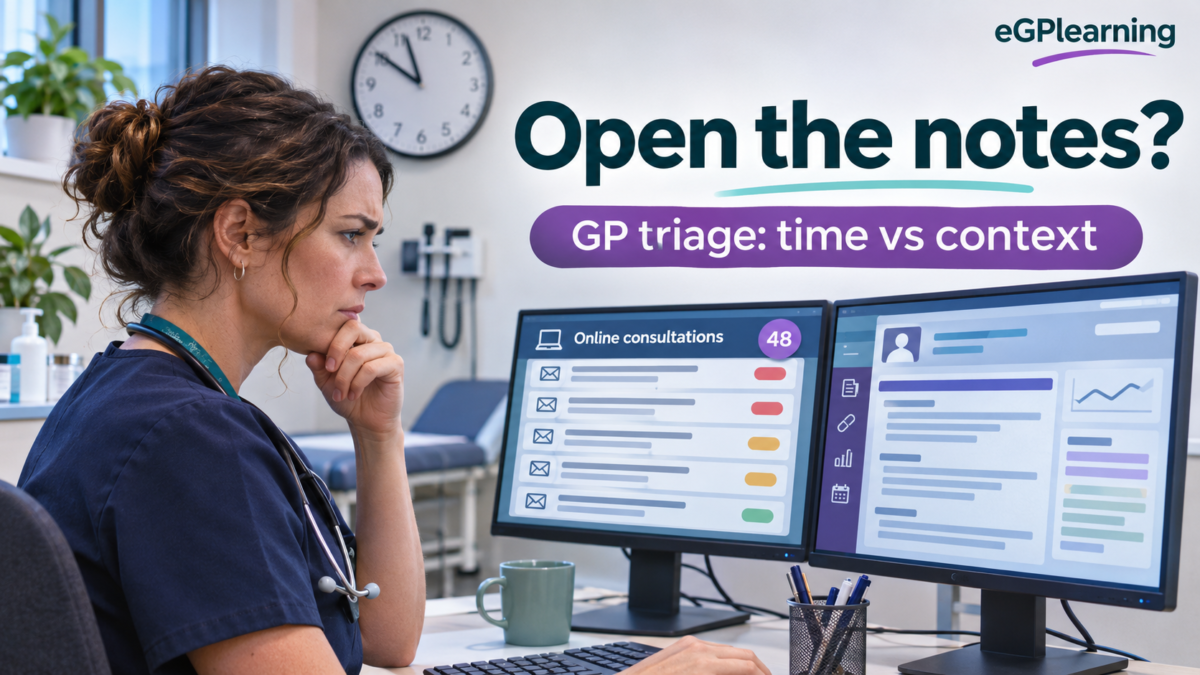
Should GPs open the notes when triaging?
I think we’re asking the wrong question.
DrGandalf 2026
A recent discussion in a group of clinicians surprised me.
The question was straightforward: when reviewing online consultations, should GPs open the patient’s clinical record?
I assumed most would say yes.
Apparently not.
Several clinicians felt they could make an appropriate triage decision using the information presented by the online consultation platform alone. Their primary job was to decide whether the patient needed an appointment, how urgently, and potentially who they should see.
If the request was particularly complex, they could open the notes then.
And I can understand that position.
When you’ve got a substantial list of requests to work through, opening every record adds time. Sometimes the information on the form genuinely is enough to make an immediate decision.
But I approach it differently.
I routinely open the clinical record when undertaking clinical triage because I don’t think the decision is simply whether someone needs an appointment.
I want to know what’s already happened, whether there’s an existing plan, whether someone has recently assessed the same problem, and whether the patient’s next step actually needs to be another consultation.
Sometimes that review takes seconds. Sometimes it takes considerably longer.
And that’s where the argument becomes interesting.
Because opening the notes might make an individual triage decision slower. But could it also make the overall patient journey safer, more appropriate and potentially more efficient?
Or am I creating unnecessary clinical work when a quicker decision would have been perfectly reasonable?
Not all triage is created equal
One problem with discussing online consultation triage is that we often talk as though every practice operates the same model.
They don’t.
Some practices triage predominantly acute, on-the-day demand. The main decision is how urgently someone needs assessing and who should provide that assessment.
Others operate total triage, reviewing everything from acute illness to chronic disease, routine requests and administrative queries.
Some primarily triage routine, non-urgent demand.
Our practice uses an on-the-day total-triage model, where appointment capacity is a constant consideration.
These differences matter.
A GP deciding whether someone with acute abdominal pain needs immediate assessment is making a different decision from someone reviewing a request about persistent knee pain, a referral delay or medication that isn’t working.
Both decisions need to be safe. But they may need different amounts of information.
And NHS England’s guidance recognises different approaches to triage rather than requiring every practice to operate total triage.
The online form isn’t the whole story
There’s another variable that doesn’t always receive enough attention: the online consultation platform itself.
Some systems collect relatively brief, open-ended descriptions.
Others use detailed questionnaires, branching questions or increasingly AI-generated summaries or even AI driven decisions.
The clinician might receive two sentences or several pages of information.
More information sounds helpful, but it isn’t automatically better information.
A detailed questionnaire might identify important symptoms and red flags. Equally, critical information may be buried within dozens of answers.
A short submission might be beautifully concise but miss important context.
And even a comprehensive questionnaire may not tell me that the patient was assessed earlier in the week, that a particular clinician already knows their history, or that an existing plan simply needs progressing.
The online consultation tells me what the patient has submitted. The clinical record helps me understand where they’ve been.
I need enough information from both to make the decision in front of me.
General practice has something particularly valuable
This is where I think general practice has a significant advantage.
We hold a longitudinal clinical record.
Not a perfect record. Not every hospital interaction, community contact or investigation necessarily makes it into our systems, and the information we receive may be delayed or incomplete.
But for many patients, the GP record provides a remarkable picture of their healthcare journey.
Years of consultations, diagnoses, medications, investigations, correspondence, referrals and management decisions.
Other services increasingly have access to elements of GP records. NHS 111, for example, can use GP Connect to view information through authorised systems, so it would be wrong to suggest that 111 clinicians are always working with only a Summary Care Record.
Nevertheless, accessing information and delivering continuity aren’t identical.
General practice can often combine the patient’s previous history with knowledge of local services, existing clinical relationships and the ability to continue an established management plan.
If we have access to that longitudinal story, why would we routinely choose to make clinical decisions without considering it?
Capacity changes the question
Let’s acknowledge another uncomfortable reality that the papers won’t tell you.
Many practices don’t have enough appointment capacity to accommodate every request with another consultation.
That isn’t a justification for denying clinically necessary appointments. But it does mean triage must achieve more than simply organising a queue.
Triage is about allocating the clinical resources we have to those who need them most.
And need isn’t necessarily determined by who asks first, who shouts the loudest or who writes the most convincing online consultation.
Some patients explain their symptoms brilliantly. Others struggle with language, communication, health literacy or simply recognising how significant their symptoms might be.
A short, understated request might represent something considerably more serious than a detailed, urgent-sounding submission.
Equally, repeated requests or strongly expressed concerns may reflect health anxiety, genuine deterioration or unmet clinical need. We shouldn’t dismiss those either.
The challenge is distinguishing how urgently someone needs care from how effectively they request it.
And that becomes even harder when appointment capacity has gone.
If someone genuinely needs clinical assessment, the absence of an appointment doesn’t make that need disappear. We still have to determine the urgency and find a safe way forwards, including escalation where necessary.
This is where opening the record can make a difference.
Previous consultations, comorbidities, vulnerabilities, investigations and existing management plans can provide context that simply isn’t apparent from the online form.
One patient might need urgent assessment. Another might benefit from continuity with a clinician who knows them. A third might need an existing referral chased or treatment plan progressed rather than another appointment. A fourth may need to persevere with the existing plan or wait watchfully.
But I want to understand that before deciding.
The less capacity we have, the more important it becomes to understand who needs that capacity most.
Research suggests that a substantial proportion of online consultation requests can be resolved without a subsequent appointment. A University of Bristol modelling study used a 30% completion estimate drawn from earlier evidence, while an NHS South West London practice case study reported more than a third of requests resolved without an appointment. [1, 2]
But these figures aren’t interchangeable. Some datasets include administrative requests, while others focus on clinical consultations. And resolving a request without another appointment doesn’t mean no clinical or administrative work was involved.
That’s why I think the value of triage isn’t just avoiding appointments. It’s identifying who genuinely needs one, and helping everyone else take the most appropriate next step.
Of course, reviewing records and progressing care takes time. It doesn’t magically create appointments, nor does it replace listening to patients or seeking further information when necessary.
And sometimes an appointment really is the only appropriate option.
So I wouldn’t measure successful triage simply by the number of appointments avoided.
Otherwise, are we navigating patients towards better care, or merely navigating them away from our appointment book?
The objective is the best journey for the patient, not simply the smallest number of consultations.
But there’s a cost to opening the record
Here’s the strongest argument against my position.
Time. The most valuable resource.
Imagine 100 requests requiring clinical triage.
An additional minute reviewing each record creates 100 minutes of work.
That’s significant when decisions need to be made promptly and there’s already substantial demand.
Opening the notes also introduces cognitive load which can lead to clinician exhaustion, burnout and patient risk.
A clinician can also become distracted by historical problems, anchor onto an existing diagnosis or spend time investigating information that doesn’t materially affect the current decision.
And there’s a genuine danger of turning every triage request into another consultation.
I don’t think the answer is to abandon record review.
I think it’s to be deliberate about its purpose.
When I open a record, I’m looking for relevant context. Has this person been seen recently? Is there an existing plan? Are there important clinical risks? Does someone already know them? What’s the next appropriate step?
That isn’t the same as comprehensively reviewing every historical entry.
You opened the notes. Now whose problem is it?
This might be the most uncomfortable question of all.
What happens when you open the record to triage a straightforward request and notice something potentially significant for that patient that changes their journey and how their care needs to be managed?
An abnormal result. An outstanding investigation. A follow-up that never happened. You disagree with the previous assessment.
Have you just inherited responsibility?
I don’t think opening the record automatically makes the triaging GP responsible for every unresolved issue in a patient’s history.
But if you identify something that presents a significant risk, deliberately ignoring it is difficult to justify.
There needs to be a proportionate response.
Sometimes that means taking immediate action. Sometimes it means returning the issue to the responsible clinician or team, with a clear handover.
This is also a systems issue.
Practices need reliable processes for unexpected findings, task allocation and escalation. Otherwise, the safest and most conscientious triagers may end up accumulating work simply because they noticed something.
That’s hardly a sustainable model.
What about indemnity?
The medico-legal argument is worth separating from the clinical one.
In England, the Clinical Negligence Scheme for General Practice covers clinical negligence claims arising from eligible triage activity under GP contracts, including online requests.
That doesn’t mean opening the full record is a condition of indemnity.
Nor does indemnity mean that any particular triage decision was safe.
The relevant question is whether the clinician made a reasonable decision with sufficient information, considering the circumstances and clinical risks.
The GMC expects clinicians to use appropriate information when making clinical decisions, particularly where prescribing is involved.
So opening the notes doesn’t automatically make a decision defensible.
But failing to consider readily available, clinically relevant information may be difficult to explain if that information would reasonably have changed the decision.
So, should GPs open the notes?
For me, yes.
When I’m undertaking clinical triage, my default is to open the patient’s record.
Not to read everything. Not to investigate every historical problem. And certainly not to turn every online request into a full consultation.
But to understand the relevant context before deciding what happens next.
That might take 20 seconds. It might take two minutes. I won’t deny there have been times it took longer. Occasionally, the information I discover means the patient needs something much more substantial.
And I recognise that every additional minute matters when you’re managing dozens, sometimes hundreds (yes hundreds) of requests.
I also recognise that clinicians working in different triage models may reasonably reach different conclusions about how much information they need.
But here’s what I keep coming back to.
If the record could change the decision, shouldn’t we be looking at it before making that decision?
General practice holds something genuinely valuable: a longitudinal account of the patient’s healthcare journey.
It isn’t complete, and it isn’t infallible. But it gives us an opportunity to connect today’s request with yesterday’s consultation, last month’s investigation and tomorrow’s management plan.
I don’t want us to lose that advantage simply because we’re trying to get through the triage list faster.
Equally, I don’t want to pretend that opening the notes is cost-free, or that every extra minute of record review provides additional clinical value.
Perhaps that’s what we should be measuring.
Not just how quickly we triage a request, or how many appointments we avoid, but whether the decision actually delivers the best journey for the patient.
So I’d genuinely like to hear from colleagues on both sides.
If you don’t routinely open the record, what gives you confidence that the information in the online consultation is enough? And if you do open it, how do you balance the value of that additional context against the time it takes?
Because perhaps the real debate isn’t whether we should open the notes.
It’s how much we need to read before we know enough to make the right decision.
References for appointment-resolution figures
1. Salisbury C, Murphy M, Duncan P. The Impact of Digital-First Consultations on Workload in General Practice: Modeling Study. Journal of Medical Internet Research. 2020. https://pmc.ncbi.nlm.nih.gov/articles/PMC7327596/
2. NHS South West London Integrated Care Board. How local GPs are harnessing new technology to benefit patients. Holmwood Corner Surgery case study. https://www.southwestlondon.icb.nhs.uk/news/how-local-gps-are-harnessing-new-technology-to-benefit-patients/