
NHS Survivor Series: Welcome to WarGames aka SPoA!
Primary care, secondary care, five referral teams and one patient. Everyone’s entered the cage. But who’s actually going to finish the match?
Dr Gandalf | eGPlearning | November 2026
There was a time when referring a patient from general practice to hospital was relatively straightforward.
Not necessarily easy. Not necessarily quick. And certainly not without the occasional disagreement.
But at least you knew who you were wrestling.
For years, NHS referrals resembled the traditional WWE Survivor Series.
Two teams. Five competitors on each side. One ring. A relatively simple set of rules.
Team Primary Care versus Team Secondary Care.
The GP versus the consultant.
The ANP in primary care versus the specialist clinic nurse.
And somewhere at ringside, the medical secretary desperately trying to establish whether the referral had actually arrived.
The GP would assess the patient, organise investigations and make the referral.
Occasionally, the consultant would deliver an unexpected clothesline.
“Referral rejected. Please arrange further investigations.”
Sometimes reasonable.
Other times, it felt like receiving a Stone Cold Stunner from someone who hadn’t actually read the referral.
But at least the teams and responsibilities were relatively clear.
Then somebody in NHS management watched Survivor Series and thought:
“This is far too simple. What if we made it WarGames?”
From Survivor Series to WarGames
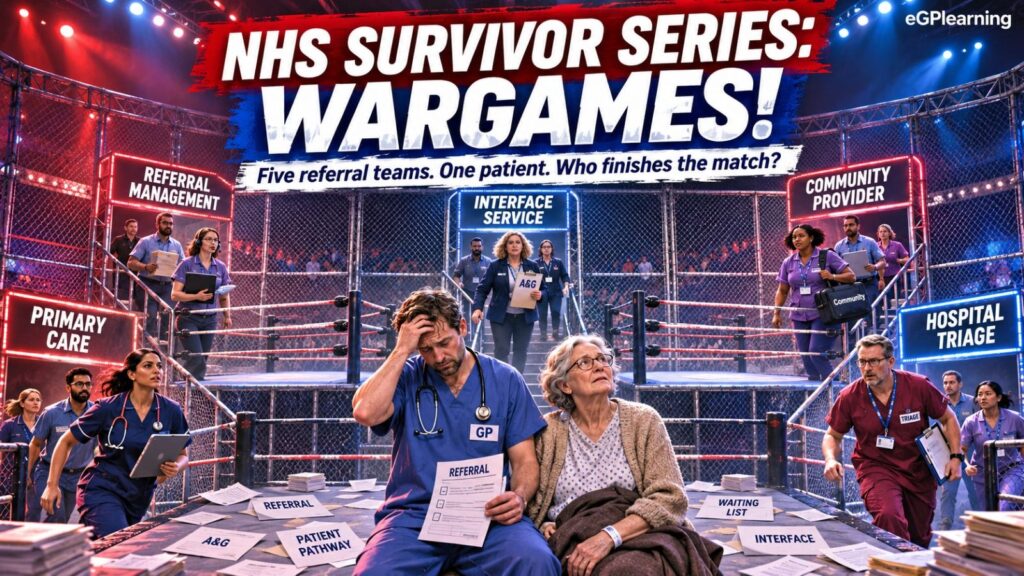
For the uninitiated, WarGames involves two wrestling rings surrounded by an enormous steel cage, with competitors entering at staggered intervals.
It’s spectacular entertainment.
It’s also beginning to resemble the modern NHS referral pathway.
Welcome to the Single Point of Access.
Or SPoA, because the NHS has never encountered a concept it couldn’t improve with an acronym.
The principle makes sense.
Referrals enter a single pathway, where specialist clinicians determine the most appropriate next step.
That might be an outpatient appointment, an investigation, community management or specialist Advice and Guidance (A&G).
Done well, SPoA could reduce unnecessary appointments, improve communication and ensure patients reach the right care.
Done badly?
It’s five different assessments, three organisations, another set of referral criteria and a patient who still hasn’t received the care they need.
And the cage door has just slammed shut.
Who booked this match?
Let’s address the elephant in the arena.
The NHS waiting list.
Millions of patients waiting for specialist appointments and treatment is unacceptable.
NHS England has promoted greater use of A&G and SPoA, with consultant-led triage being introduced across locally selected priority specialities from October 2026. [1,2]
The attraction is obvious.
If patients can receive appropriate specialist input without a traditional outpatient appointment, they may get help sooner while hospital capacity is preserved for those who need it.
That’s a genuine potential benefit.
But there’s a difference between avoiding an unnecessary appointment and making a necessary appointment harder to obtain.
NHS England has explicitly stated that SPoA should not be used as a referral-rejection mechanism. It has also clarified that there is no national target requiring a fixed percentage of referrals to be diverted. [2]
Those reassurances matter.
So does the distinction between what the policy says and what actually happens.
Are we measuring whether patients receive appropriate care, or simply celebrating that fewer patients appear on hospital waiting lists?
Because an appointment avoided isn’t automatically a clinical problem resolved.
And a referral redirected isn’t necessarily work eliminated.
Welcome to our next match.
Entrant number one: The GP
The GP enters first.
Of course we do.
It’s 8 am.
Imagine a patient presenting with persistent abdominal pain for the third time.
They’ve been examined, investigated and treated appropriately, but the symptoms remain unexplained.
This is precisely the sort of situation where Jess’s Rule encourages clinicians to reflect, review and rethink the diagnosis after repeated presentations. [11]
The GP believes specialist assessment is needed.
A carefully constructed referral enters SPoA.
The GP waits for the tag.
3… 2… 1… BUZZZZ!
Entrant number two: Referral management
The music hits.
Referral management enters the cage.
They inspect the paperwork.
They check the pathway.
And then comes the first devastating move.
“Please confirm the required blood tests have been completed.”
They have.
Paragraph three.
Nevertheless, the referral returns.
The GP resubmits.
Entrant number three: The interface service
Another countdown.
The interface clinician arrives.
A skilled professional doing their best to navigate an increasingly complicated system.
They recommend community assessment.
Reasonable in some situations.
Except this patient has already been assessed and investigated.
Another form.
Another appointment.
Another waiting list.
The GP tries to leave the cage.
The door is locked.
Entrant number four: The community provider
The community clinician reviews the patient and reaches a decision.
“This patient requires specialist hospital assessment.”
Excellent.
The original plan.
We’ve completed an elaborate sequence of clinical manoeuvres and ended up exactly where we started.
In WWE, that’s technical wrestling.
In the NHS, apparently, it’s pathway optimisation.
Entrant number five: Hospital triage
The fifth competitor arrives.
They review everything.
And deliver the finishing move.
“This patient may be more appropriately managed in primary care.”
FLUB! THE REFERRAL HAS GONE STRAIGHT THROUGH THE ANNOUNCE TABLE!
Back to the GP.
No definitive answer.
No agreed management plan.
The patient is still waiting.
But somewhere, a referral has been processed.
The outpatient waiting list may look healthier.
We’ve improved the scoreboard without necessarily improving the patient’s care.
Of course, this is satire, not a description of every SPoA pathway. Well-designed services can avoid unnecessary appointments and provide rapid specialist input.
But duplicated assessments, unclear responsibilities and referrals being returned without resolving the clinical question are real concerns.
And the consequences deserve more scrutiny than the statistics alone.
The CM Punk moment: The consultant returns
Remember CM Punk returning to WWE at Survivor Series: WarGames in November 2023?
After almost a decade away, his music hit and the crowd erupted.
The best detail?
WarGames had already finished.
Which makes this a rather appropriate metaphor for specialist involvement arriving after a complicated referral journey.
The GP has fought from the beginning.
Referral management has checked the criteria.
The interface service has reviewed the case.
The community clinician has assessed the patient.
Hospital triage has completed its assessment.
And just when everyone thinks it’s over…
LOOK IN MY EYES…
IT’S THE CONSULTANT!
The crowd goes wild.
Finally, the specialist we’ve been trying to access!
The consultant reviews the case and delivers an absolutely devastating finishing move.
“Have you considered repeating the blood tests in six weeks?”
The crowd falls silent.
Somewhere, a practice manager cancels their annual leave.
Now, the consultant might be entirely reasonable.
They may also be as frustrated with the process as the GP.
The problem isn’t necessarily the consultant, the interface clinician or the referral management team.
It’s that we’ve created a match where specialist involvement can arrive after everyone else has already fought it.
And the patient is still waiting for an answer.
Who actually owns the patient?
WarGames has one distinct advantage over some NHS pathways.
Everyone knows the rules.
Everyone understands what victory looks like.
And the match has an ending.
In the NHS, five services can review a referral, four clinicians can offer opinions and three organisations can document their involvement.
Yet one patient can remain without a definitive plan.
Everyone has contributed.
Everyone has followed their procedure.
But who is responsible for ensuring the patient actually receives care?
We’ve confused involvement with accountability.
This is the classic problem of diffusion of responsibility.
When multiple organisations are involved, everyone can believe someone else is responsible for the next step.
For patients, that can mean confusion about who to contact, whether they remain on a waiting list and whether somebody is actually progressing their care.
For GPs, it can mean remaining responsible for managing clinical uncertainty without having access to the specialist assessment they requested.
A referral returned with advice isn’t necessarily a resolved clinical problem.
Especially when the advice creates more work, more delay or further uncertainty.
Even Sir Chris Whitty is questioning the booking
This isn’t simply another disagreement between primary and secondary care.
On 4 November 2026, England’s Chief Medical Officer, Professor Sir Chris Whitty, warned that overusing A&G risks taking the NHS in the wrong direction. [5]
Speaking to Pulse, he recognised the benefits of specialist advice, particularly where patients might otherwise have difficulty accessing hospital services.
But he also acknowledged that poorly used A&G can introduce unnecessary delays for patients who require outpatient assessment.
That’s the fundamental distinction.
Specialist advice should support clinical decision-making, not become an obstacle to specialist assessment.
His comments don’t amount to an argument against A&G.
They’re an argument for using it appropriately.
And importantly, they acknowledge the same tension many GPs have been highlighting: a pathway designed to improve access can do the opposite when implemented badly.
Even the referee is questioning the rules.
The LMCs have entered the cage
The profession has been raising concerns about inappropriate A&G for some time.
In November 2024, England’s LMC conference challenged the use of pathways that shifted inappropriate workloads into general practice. [6]
In May 2026, the UK LMC conference supported calls for A&G to remain optional and not delay necessary specialist care. Nottinghamshire LMC’s Dr Jessica Court highlighted the importance of respecting GPs’ clinical judgement when requesting assessment. [7]
And the debate is continuing.
On 20 November 2026, representatives at England’s LMC conference are due to consider a motion calling for an unequivocal contractual right to refer directly when clinically necessary. [9]
The proposed motion also calls for monitoring of rejected and delayed referrals, including subsequent diagnoses, emergency admissions and patient harm.
That’s important.
Because this isn’t simply about GPs disliking additional paperwork.
It’s about patient safety.
In August 2026, the Health Services Safety Investigations Body published an interim report identifying examples where A&G processes had contributed to delays, missed diagnoses and patient harm. [8]
Crucially, it also identified examples where A&G improved patient care.
The investigation did not establish how widespread the problems were, so it would be wrong to conclude that all these pathways are unsafe.
But the findings demand attention.
A system can work extremely well in one locality and cause serious difficulties in another.
A completed electronic referral workflow is not the same as a completed episode of patient care.
And the NHS needs to understand what happens after referrals are redirected.
Not simply how many are redirected.
The ultimate finishing move: Unfunded work transfer
Now comes the move every GP partner recognises.
THE UNFUNDED WORK TRANSFER!
It doesn’t have dramatic entrance music.
It rarely appears on a performance dashboard.
But it keeps general practice trapped inside the cage.
A patient is referred for specialist assessment.
Instead of an appointment, the practice receives a response.
“Please arrange additional investigations.”
“Please initiate treatment and monitor.”
“Please review in six weeks.”
“Please refer again if symptoms persist.”
Some requests will be reasonable components of routine general practice.
Others represent specialist-pathway work being returned without agreement, additional capacity or funding.
And every task has a cost.
Reviewing correspondence.
Contacting the patient.
Arranging investigations.
Explaining results.
Managing uncertainty.
Reviewing again.
Potentially referring again.
Multiply that across thousands of referrals and a reduction in hospital activity can create substantial additional work elsewhere.
Work that consumes general practice capacity and reduces the time available for other patients.
This is why the argument matters beyond the GP profession.
If additional unfunded clinical work fills appointment capacity, it can reduce public access to general practice.
And that has consequences for patients who weren’t even involved in the original referrals.
What’s particularly frustrating is that the national guidance already recognises this.
NHS England’s April 2026 letter states that investigations required as part of specialist pathways should be organised and followed up by secondary care, rather than simply passed back to practices. [2]
The BMA’s GPCE guidance explicitly warns against using A&G or SPoA to transfer unfunded work into general practice. [3,4]
So why are we still arguing over who should organise the next investigation?
The problem isn’t always what the guidance says.
It’s what happens when the referral comes back.
We’re constantly told that care should move closer to home.
That’s a reasonable ambition.
But moving care closer to home should mean moving the staff, resources and expertise alongside it.
Not simply relocating the responsibility and describing the result as integration.
General practice is not an unlimited holding bay for work that doesn’t fit another organisation’s performance targets.
And secondary care clinicians are not automatically the villains here either.
They face their own capacity constraints, waiting-list pressures and clinical responsibilities.
The system is asking both sides to make limited resources stretch further.
But transferring work doesn’t eliminate the cost.
It merely changes who pays it.
The Road to WrestleMania
And our storyline has another event approaching.
March 2027.
WrestleMania season.
NHS England has commissioned an external evaluation of A&G and SPoA, with written interim findings expected between December 2026 and March 2027 and a final report anticipated in summer 2027. [10]
A rather appropriate title suggests itself.
The Road to WrestleMania: SPoA versus the Evidence.
Will the evaluation demonstrate that patients receive faster, safer specialist care?
Will it measure the additional workload created in general practice?
Will it examine delayed referrals, repeated consultations and patient outcomes?
And if the evidence suggests significant problems, will the NHS change course?
Because I’m not against SPoA.
I’m not against A&G.
And I don’t believe every patient needs a traditional outpatient appointment.
Good specialist advice can improve care and avoid unnecessary hospital visits.
But a successful system needs clear clinical responsibility, effective communication, properly resourced pathways and meaningful monitoring of outcomes.
Not just another layer of triage.
The final bell: Who wins?
Professional wrestling understands something the NHS occasionally seems to forget.
A match needs a finish.
Someone needs to win.
And in healthcare, that winner should be the patient.
We’re good at measuring hospital waiting lists.
We’re increasingly interested in counting outpatient appointments avoided.
But are we measuring the work transferred into general practice?
The repeat investigations?
The additional consultations?
The unresolved clinical problems?
The patients who don’t know whether they’re waiting for an appointment or just waiting for someone to make a decision?
Reducing hospital waiting lists isn’t necessarily the same as reducing patients’ waiting time for care.
Reducing outpatient appointments isn’t necessarily the same as reducing NHS workload.
And transferring responsibility isn’t the same as transferring the resources needed to deliver it.
A well-designed SPoA could make things significantly better.
Patients could receive timely specialist input. Clinicians could communicate more effectively. Investigations could be organised without duplication. Specialist capacity could be preserved for the people who need it most.
But achieving those benefits requires more than a new electronic referral destination.
We need clear clinical ownership, defined responsibilities for investigation and follow-up, meaningful escalation when the referring clinician remains concerned, and proper monitoring of patient outcomes.
And when care moves between organisations, resources must follow.
Integration cannot simply mean making one part of the NHS responsible for another part’s workload.
Otherwise, we’re not improving healthcare.
We’re redesigning where the pressure lands.
Because if the objective of WarGames is to win the match, the objective of NHS integration should be to get patients the care they need.
Not simply to make one team’s performance figures look better.
And if we really need a surprise entrance from CM Punk?
Let’s make sure the consultant arrives before the match is over.
Because the NHS can’t keep celebrating victories in reducing hospital waiting lists while general practice is left inside the cage, wrestling with the workload that everyone else has walked away from.
The bell might have rung for secondary care.
But for general practice, the match is still going.
And nobody has funded the next round.
References and further reading
- NHS England (2025). Medium Term Planning Framework: Delivering Change Together 2026/27 to 2028/29. National planning and outpatient transformation context.
- NHS England (22 April 2026). Specialist advice and elective single point of access – what this means for you and your patients. Referral rights, absence of national diversion targets, responsibilities for investigations and clinical escalation.
- British Medical Association (2026). GPCE updated guidance on Advice and Guidance and Single Point of Access. Clinical judgement, referral management, accountability and unfunded workload.
- British Medical Association. External un-resourced workload: Safe working in general practice. Professional guidance on responsibilities and unresourced work.
- Hetherington H, Pulse (4 November 2026). ‘We’ll end up in the wrong place’ if A&G is ‘overused’, warns CMO. Chris Whitty’s comments on the benefits and risks of A&G.
- Parr E, Pulse (22 November 2024). Stop using ‘workload dump’ A&G pathways, LMCs urge GP practices. LMC concerns about workload transfer.
- Colivicchi A, Pulse (13 May 2026). A&G must be ‘optional’ or it will delay patient care, warn GP leaders. UK LMC conference debate.
- Health Services Safety Investigations Body (18 August 2026). Electronic patient record systems – electronic referrals for ongoing care: Advice and Guidance. Interim investigation of patient safety, pathway implementation and referral risks.
- Colivicchi A, Pulse (27 October 2026). GP leaders to vote on pushing for ‘unequivocal contractual right’ to refer. Proposed November 2026 LMC conference motion.
- Colivicchi A, Pulse (2 October 2026). NHS England commissions ‘external evaluation’ of advice and guidance. Evaluation commissioning and expected reporting timetable.
- NHS England (23 September 2025; updated 2026). Jess’s Rule: Three strikes and we rethink. Guidance on reviewing repeated or unexplained presentations.