
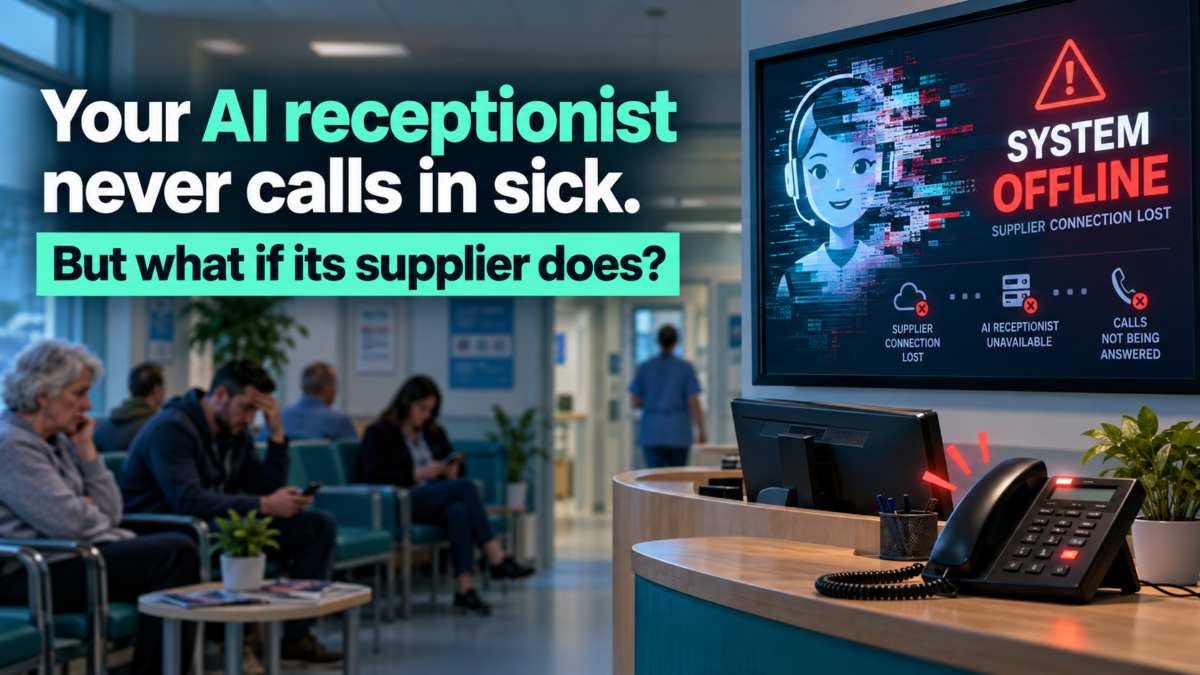
Your AI receptionist never calls in sick. But what if its supplier does?
The Budget makes employing people more expensive. AI looks increasingly attractive. But the collapse of Silicon Practice raises uncomfortable questions about the future of general practice.
30 October 2026 | DrGandalf
An AI receptionist doesn’t take annual leave.
It doesn’t call in sick on Monday morning. It doesn’t need maternity cover, doesn’t require pension contributions and won’t ask for a pay rise every April.
Its costs are relatively predictable, and depending on the system, it can handle multiple patient conversations simultaneously.
For a GP partner or practice manager staring at their staffing budget, that’s quite an attractive proposition.
But there’s something an AI receptionist can do that your human receptionist generally can’t.
Disappear overnight because the company providing it has gone bust.
And this week, general practice has been given a rather uncomfortable reminder of what that looks like.
The Budget has changed the maths
Wednesday’s Autumn Budget confirmed that the National Living Wage will increase by 3.9%, from £12.71 to £13.21 per hour, from April 2027. [1]
For the people receiving that increase, this is welcome news. Receptionists, administrators and healthcare assistants deserve reasonable pay for the work they do.
But for GP practices, there’s a considerably more complicated financial reality.
Earlier this month, DHSC and NHS England submitted evidence to the Doctors’ and Dentists’ Review Body outlining financial plans that currently assume a 2.4% NHS pay uplift for 2027/28. [2]
That’s not an agreed GP contract increase, nor does it mean practice income will rise by 2.4%. We don’t yet know the final arrangements for general practice.
But we do know there will also be an additional ask from General Practice as well. The contract raise is never just to account for extra costs; it also includes extra work, and likely even more so in the developing world of Neighbourhoods and the progressive left shift from secondary care – both of which have been identified with no additional funding.
So the direction of travel is challenging.
The minimum wage increases by 3.9%.
NHS financial planning currently assumes 2.4% for pay, with productivity improvements expected
Who makes up the difference?
Because in general practice, we know where financial pressures eventually land.
GP partners will be required to balance the books or the practice may have to close, because there is no bailout for practices, unlike what is often seen in the rest of the NHS.
The pay rise that doesn’t stop at minimum wage
Here’s something that gets overlooked in discussions about minimum wage increases.
Imagine your entry-level receptionist currently earns £12.71 an hour.
Your experienced receptionist earns £13.50. Your senior care navigator earns £14.50.
From April, that entry-level salary must increase to £13.21.
Suddenly, the difference between somebody who’s just joined the practice and somebody who’s spent years developing their knowledge, skills and experience has narrowed considerably.
Do you leave those higher salaries unchanged?
You legally can, assuming they remain above the applicable minimum. But what does that do for morale, retention and recognition of responsibility?
Alternatively, you increase everybody’s salary by 3.9%.
Now you’re applying that percentage to your entire pay structure, not just those previously earning minimum wage. Add employer National Insurance and pension contributions (typically about a 30% cost to the business), and the financial impact grows further.
This is wage compression, with upward pressure on pay across the organisation. Even the Government’s own DDRB evidence recognises that increases in the National Living Wage contribute to reduced pay differentials. [2]
And the costs don’t end there.
Practice premises still need maintaining. Electricity and heating bills need paying. Equipment needs replacing. Software subscriptions increase. Clinical consumables cost money. Inflation affects the services we buy, while medication cost pressures affect the wider NHS, prescribing decisions and workload.
Not every one of these costs rises by the same amount, but they’re all competing for the same finite resources, and we all know the impact of inflation on costs at present.
For a detailed financial breakdown, Tara Humphrey, a friend of eGPlearning, has produced a practical resource exploring these costs, including a calculator to estimate the impact on your own practice.
Autumn Budget 2026: What will the minimum wage rise cost your practice? — THC Primary Care
I’d recommend GP partners and practice managers explore it before planning next year’s staffing budget.
Nobody needs to tell practices to replace people with AI
Here’s the uncomfortable part.
Government doesn’t need to announce a policy encouraging practices to replace receptionists with artificial intelligence.
It simply needs to create an environment where employment costs keep rising, financial headroom remains constrained, and practices are expected to become more productive.
I’m not suggesting that replacing receptionists is an explicit government policy. There’s no evidence for that.
But I do question whether the combined effect of funding decisions, employment costs and productivity expectations will increasingly encourage exactly that outcome.
And there’s another incentive we shouldn’t ignore.
The GP contract is increasingly interested in how quickly patients get through to us.
The 2026/27 contract introduced greater scrutiny of patient access, including monitoring call-waiting times between 8am and 10am and across core hours. Practices are expected to share data through cloud-based telephony arrangements, alongside wider information about patient access. [8]
National monitoring doesn’t automatically mean a nationally mandated two-minute answering target. But it does put telephone performance under greater scrutiny.
And some practices face additional locally commissioned access requirements, including schemes that may incentivise shorter waiting times. These vary between areas and are not universal contractual standards.
Now consider the potential attraction of AI.
An AI receptionist could potentially answer immediately, regardless of whether 20 patients ring simultaneously or 50, subject to the platform’s capacity.
No queue. No additional staff rota. No Monday morning scramble to answer the phones.
And if the system’s activity is accurately reflected in the telephony data, it could significantly improve reported access performance.
But are we measuring how quickly somebody answers, or how effectively the patient’s problem is resolved?
Those are not necessarily the same thing.
A patient whose call is answered instantly by AI, only to be transferred into another queue, hasn’t necessarily experienced better access.
An impressive dashboard is not the same as a better patient journey.
Yet when practices face pressure to improve telephone metrics alongside rising staffing costs, the commercial argument for automation becomes increasingly difficult to ignore.
Have we actually asked patients if they want this?
There’s another uncomfortable question in this debate.
Have we properly asked patients whether they want AI receptionists managing their contact with general practice?
I’m not aware of any comprehensive national patient consultation establishing support for widespread replacement of traditional GP reception interactions with AI.
Individual practices may engage with their Patient Participation Groups, undertake surveys and involve patients in implementation. Some will do this well.
But at a wider system level, are we simply assuming patients will adapt?
We’ve already seen similar changes in banking, energy companies and other customer-facing industries, and the backlash that exists.
Automated telephone menus, chatbots and digital-first customer support have become routine. They can be convenient, efficient and available outside traditional opening hours.
They can also be incredibly frustrating when you simply want to speak to a person.
Now consider the difference between asking your bank about a missing payment and contacting your GP because you’re frightened about a new symptom.
For some patients, an AI receptionist might be a revelation.
No waiting on hold. No embarrassment about explaining a sensitive problem to somebody they know. A consistent response, potentially available in multiple languages, with accessible options for patients who struggle with conventional telephone systems. They can increase access and break down barriers in health inequalities.
For others, it could become another obstacle.
Patients with limited digital literacy, communication difficulties, hearing impairment, cognitive impairment or language needs may require additional support. Some might be uncomfortable explaining sensitive information to an automated system, even when appropriate safeguards are in place.
And then there’s safety.
What happens when the patient doesn’t explain their symptoms clearly? When they misunderstand the question? When the system misinterprets a response or fails to recognise urgency?
These aren’t necessarily reasons to reject AI reception.
They are reasons to design it properly.
Human escalation, accessible alternatives, appropriate clinical risk assessments, clear explanations about the use of AI and meaningful patient involvement can all help manage these risks.
And we shouldn’t pretend human reception systems are infallible either. Long waits, missed calls, and inconsistent navigation already create barriers and risks.
The question is whether we’re improving access for patients, or simply moving the barriers somewhere cheaper for practices to manage.
If financial pressures accelerate adoption, meaningful patient engagement becomes more important, not less.
Receptionists aren’t just people who answer telephones
Before anybody accuses me of advocating replacing reception teams with chatbots, here’s the important counterargument.
A good receptionist understands far more than a set of appointment-booking rules.
They recognise patients who need additional support. They know local services, the peculiarities of the practice, and sometimes the difference between what a patient requests and what they actually need.
They can recognise uncertainty, respond to distress and use judgement developed through experience.It’s the human touch we all want and sometimes need.
AI may increasingly support some of these activities, but that doesn’t make the human contribution redundant.
There’s also limited evidence that minimum wage increases automatically cause widespread job losses. The Low Pay Commission’s latest assessment has not found robust evidence of significant employment reductions from recent increases. [3]
So we shouldn’t pretend that fewer receptionists are inevitable.
The more likely possibility, in my view, is a changing workforce: fewer people spending their day answering repetitive calls, with remaining staff taking on more complex care-navigation and patient-support responsibilities.
That could be a genuine improvement.
But what happens when we’ve designed our practice around that model, reduced our staffing capacity, and the technology suddenly disappears?
Silicon Practice: a warning from the real world
This week, Silicon Practice, operating through Schappit Ltd, entered administration.
The consequences for general practice were immediate.
FootFall online consultations, practice websites and chatbot services became unavailable to affected practices. NHS communications advised practices to provide alternative routes for patients seeking clinical support. [4]
Contemporaneous reporting described hundreds of practice websites being affected, with patients losing established digital routes into their GP surgeries. [5]
Think about that for a moment.
These aren’t experimental features that somebody installed for a demonstration.
For many practices, websites and online consultation platforms have become essential components of how patients access care.
And suddenly, they weren’t there.
Now imagine extending that dependency to your telephone system, reception processes, appointment navigation, administrative workflows and the accumulated operational knowledge sitting inside an AI platform.
What happens when that provider ceases trading?
What happens to all the work your team has done configuring the system?
The appointment rules, escalation processes, carefully refined responses, local knowledge and decisions built into its operation?
Can you export that information?
Can another provider use it?
Or does your practice have to start again?
To be clear, the Silicon Practice incident does not establish that practices permanently lost all their data or configurations. The confirmed issue is disruption to services. But it has caused chaos. For those affected here are some tools to help covered in our eGPlearning episode below.
But it’s precisely the kind of failure that should make us ask harder questions before technology becomes indispensable.
If your AI receptionist disappeared tomorrow, how many actual receptionists would you need to bring back to keep your practice functioning?
And would you still have them?
If your system is designed on a tech-assisted pathway, what happens when that road is gone?
Does your team stop, or have a plan to fix the road?
Who is responsible when the technology fails?
This is where I think the discussion needs to become considerably more serious.
We rightly expect digital suppliers to demonstrate clinical safety and appropriate information governance.
NHS digital clinical safety standards, including DCB0129 for manufacturers and DCB0160 for deploying organisations, establish responsibilities for identifying and managing clinical risk. [6]
Under UK GDPR, data controllers must also assess their processors, with contracts addressing what happens to personal information when services end. [7]
But having contractual assurances isn’t the same as having an operationally tested recovery plan.
Does the practice have a usable export of its configuration?
Can a different supplier actually restore it?
Is there a documented manual fallback?
Who communicates with patients if the digital front door disappears?
How quickly can the practice return to safe operation?
And what role should ICBs and NHS England play when multiple practices rely on the same supplier?
I don’t think it is reasonable to expect every individual GP practice to undertake the equivalent of a corporate financial audit of every technology company it uses.
Practices retain responsibility for their local safety and information-governance arrangements, but commissioners and national organisations also have a role in helping practices obtain appropriate assurance and continuity support.
If we’re genuinely moving towards a digitally dependent NHS, perhaps supplier resilience, portability and exit planning need to become far more prominent requirements of procurement.
Because every AI workforce strategy needs an exit strategy.
We need to compare more than the shiny demonstrations
At eGPlearning, I’m exploring the idea of bringing several AI reception providers together in January 2027 for a comparison of their offerings.
Nothing is formally arranged yet, but I think it’s increasingly important to have this conversation.
Not just what their software can do in a carefully rehearsed five-minute demonstration.
I want to compare costs, real-world functionality, integration, patient experience, clinical safety and, critically, what happens when things go wrong.
How much workload do these systems genuinely remove?
Do they improve the patient journey, or just the telephone statistics?
Where does the human handover happen?
What happens to vulnerable patients?
And if a practice wants to change suppliers, can it take its carefully built workflows and knowledge with it?
Would a comparison like this help your practice? What would you want every provider to answer before you entrusted them with your patients?
The workforce we might be forced to create
I suspect the future of general practice will involve considerably more automation than we have today.
It might mean fewer people performing some of our traditional administrative roles.
Or it might free our existing teams to spend more time helping patients who genuinely need a human being.
Either outcome requires deliberate decisions about workforce design, financial sustainability and patient safety.
What concerns me is the possibility that we’re allowing financial pressures and access metrics to make those decisions for us, without properly considering the consequences.
The Budget makes employing people more expensive. NHS financial plans demand affordability and productivity. Telephone performance is increasingly visible. Technology suppliers offer increasingly attractive alternatives.
But Silicon Practice has reminded us that technology carries risks of its own.
An AI receptionist doesn’t need annual leave, sick pay or a pension.
But unlike your receptionist, it can disappear because somebody else’s business fails.
And the patient trying to contact their GP on Monday morning won’t care whose contract, server or balance sheet caused the problem.
They’ll simply want their practice to be there.
So here’s my question: are we deliberately designing a better workforce for general practice, with patients involved in the decision, or are we slowly pricing ourselves into technological dependency without building the safeguards to survive it?
Verified references
- National Minimum Wage and National Living Wage rates — UK Government. Supports the increase from £12.71 to £13.21 from April 2027.
- Joint DHSC and NHS England written evidence to the DDRB, 2027/28 — DHSC/NHS England, October 2026. Supports the 2.4% pay planning assumption, productivity expectations and discussion of wage compression. This is not a confirmed GP contract uplift.
- Low Pay Commission summary of evidence 2026 — Low Pay Commission, October 2026. Supports the cautious discussion of employment effects from minimum wage increases.
- Silicon Practice digital provider goes into administration — NHS ICB communication, October 2026. Confirms the loss of FootFall, practice website and chatbot availability.
- Hundreds of NHS websites offline after provider enters administration — ITV News, October 2026. Reports the scale of the disruption.
- Digital clinical safety assurance — NHS England. Explains DCB0129, DCB0160 and clinical safety responsibilities.
- Contracts between controllers and processors — Information Commissioner’s Office. Explains data-controller and processor responsibilities, including contractual exit arrangements.
- Changes to the GP Contract in 2026/27 and Supplementary information — NHS England, 2026. Supports telephone-access monitoring, cloud telephony data requirements and the stated intention of monitoring to support improvement rather than punitive performance management.
Further reading
Tara Humphrey — Autumn Budget 2026: What will the minimum wage rise cost your practice? — THC Primary Care. Practical financial analysis and calculator for staffing-cost changes.